Veronica Yakimovich
8 February, 2026
Event coverage
Tessa Wiegerinck
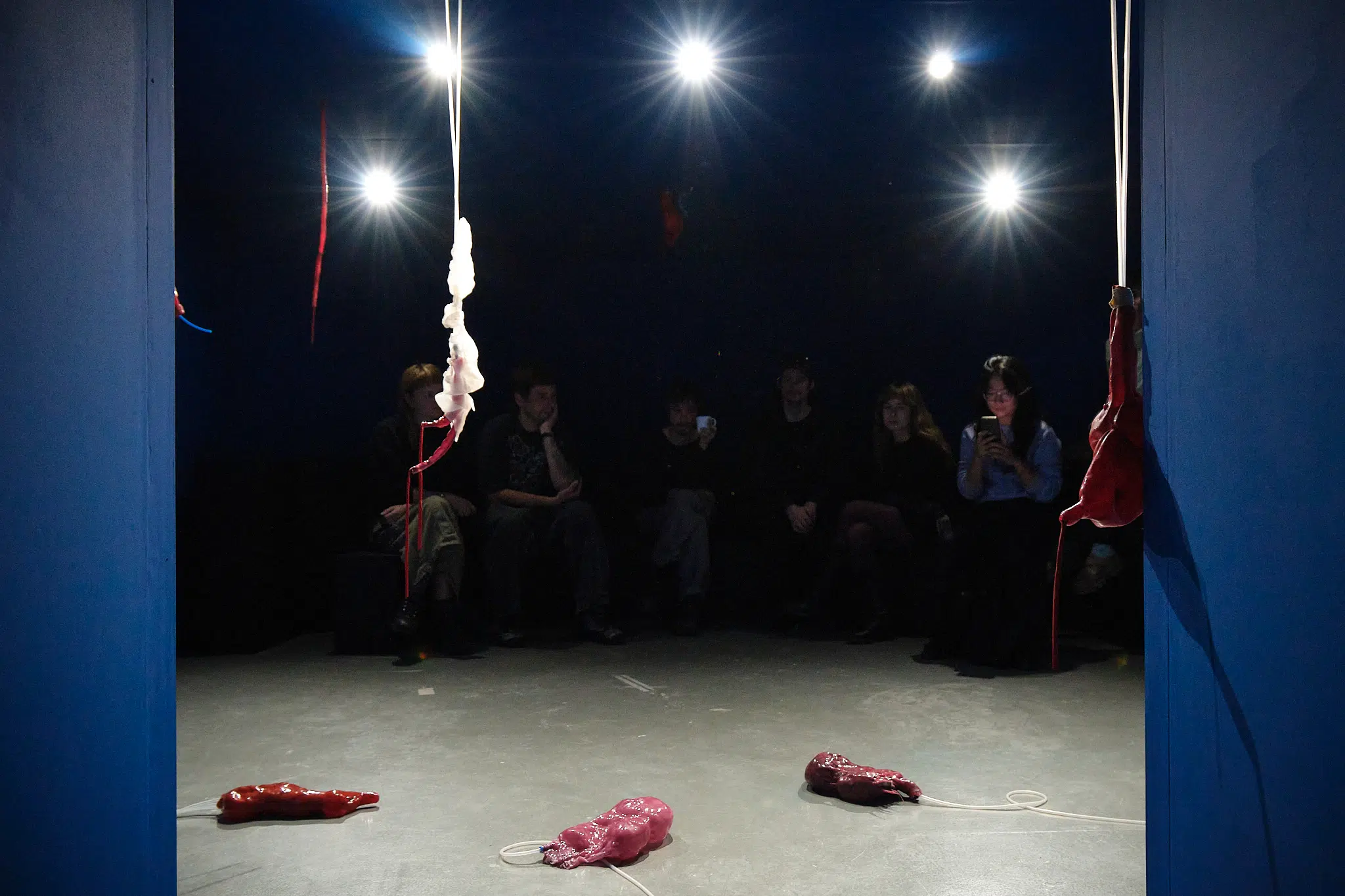
As you step into the dimly lit room, your gaze is drawn first to a clicking machine with its tubes snaking down into the unknown. Following the hall, you enter the blue shed, with objects resembling organs spread all over the space. Their resemblance to, yet at the same time their distance from, actual human organs make them disturbing yet magnetic. Connected to the tubes, ‘organs’ start to receive the air, expanding and contracting, as if breathing. At first, their movements are erratic, creating a chaotic chorus of pulses. But over time, a rhythm emerges, and the name of the installation Operation Theatre clicks into place. Organs become the performers, and their movements and sounds create a musical composition. As one of the visitors later observed, health is when you don’t notice the fragmentation of your body, when everything moves in seamless synchrony.
Almos Peled, the artist behind the installation, draws on his personal experience of growing up in a hospital as a central source of inspiration for his work. In this piece, he masterfully blurs the boundaries between technology and biology, the living and the non-living, and music and biological sound. Encountering such an intimate interpretation of what is hidden inside our bodies made me leave the room reflecting on how art can transform feelings of alienation associated with medical environments into a sense of closeness and play.
Video from: https://www.amospeled.net/operation-theatre
The panel that followed the collective visit to the installation brought together three experts from the fields of medicine, art, and government and took up precisely this question: how spaces of pain, care, fear, and hope can benefit from meaningful artistic engagement. Equipped with the pen and the notebook, I started listening to Bart Lutters, Karolina Żyniewicz, Debbie Straver reflect on this topic, complementing each other's thoughts with experiences coming from different disciplines. What follows is my personal recall of the collective engagement with the question, thus adding an additional layer of eyes and ears to the panelists’ words. Layer of the audience.
When we talk about art in medicine, this can mean different things. Starting from a more straightforward placement of artworks in hospital halls, which, in surprising ways, can prompt interesting reflections, such as seeing how art becomes less protected, with medical carts unavoidably brushing against it, yet at the same time less noticeable once it merges with the mundanity of the hospital. The main focus of discussion, however, was not on art pieces themselves, but on the role of art in helping to translate ambiguous, sophisticated individual experiences in medical settings.
As noted by one of the panelists, medical practice often puts people into boxes, which, on the one hand, can enable appropriate medicalisation, but on the other hand, strips away the individualised, personal, intimate perspective to avoid overcomplexity. Unafraid of ambiguity and messiness, artworks can give space to voices that might otherwise be reduced to a tick in a box. A telling example is the project Intimate Implant, which, through the perspective of three regenerative implants, invites viewers (if only imaginatively) to inhabit the lived experience of living with embedded technology. It asks: What does it mean when something that saves you also invades you? Art here doesn’t explain but embodies. It allows us to feel the paradox: healing that also disturbs.
Art also expands the vocabulary of care. Medicine relies heavily on language, but not everyone has the same level of language fluency. To address this, artistic practices can provide new mediums for beyond-the-language exploration. For instance, using clay to show pain, rather than merely describing it, would help build empathy and understanding not only between doctor and patient, but also between patient and their own body.
Yet, for all its potential, the way art is currently integrated into medical spaces can sometimes fall short. Not because of intent, but because of design. Existing engagement with artistic practices tends to sanitise the actual medical experience through plastic models, guided by the idea that people are repelled by their interiors, as if the body must be made palatable. But does this protect patients, or alienate them from their own reality? As Bart provocatively asked: How bad must art be to make a patient’s experience worse? Indeed, shouldn’t healing acknowledge discomfort, not mask it? If we shield patients from the truth of their bodies, are we truly taking them seriously?
These questions point to a larger tension: not only what kind of art is introduced into medical spaces, but how institutions receive, frame, and sometimes resist artistic engagement in the first place. Introducing art into medical practice therefore involves negotiating the boundaries, priorities, and safeguards of the medical environment, which still offers only limited entry points for artists and artistic processes. As Karolina mentioned, as an artist, you inevitably adjust to medical borders, and rightly so: medicine has safeguards for good reason. But where possible, shouldn’t there be room for art to challenge, to unsettle, to deepen? And as Debbie suggested, if we aspire to make health belong in every policy, maybe art deserves the same place? Not as decoration, but as essential infrastructure.
Art doesn’t just belong in medicine — it belongs to it.