

Makiko Oya-Haragi
18 April, 2026
Guest article
Visual communication sits at the heart of contemporary healthcare, yet the knowledge that makes an illustration effective (also questioning what "effective" means depends on the situation) remains largely packed. My work as a health communication specialist (PhD), trained artist (MAF), and medical illustrator focuses precisely on this gap between the drawing practice-based knowledge that skilled illustrators carry, and what impact it brings to medicine when that knowledge is diffracted through illustrations to medical professionals, patients, and the public.
In the Asia-Pacific region, including Japan, which is my home country, there is unfortunately no master-level certified licence for medical illustrators, unlike in Western countries. Yet Japan has cultivated a remarkably rich illustration ecosystem through its anime and manga industries, producing highly skilled illustrators embedded in professional communities with deep, shared knowledge. I saw this as an opportunity rather than a limitation. We can illuminate the entire practice-based knowledge of the illustration creation process, and I then envisioned that utilise that knowledge for other realms of illustration.
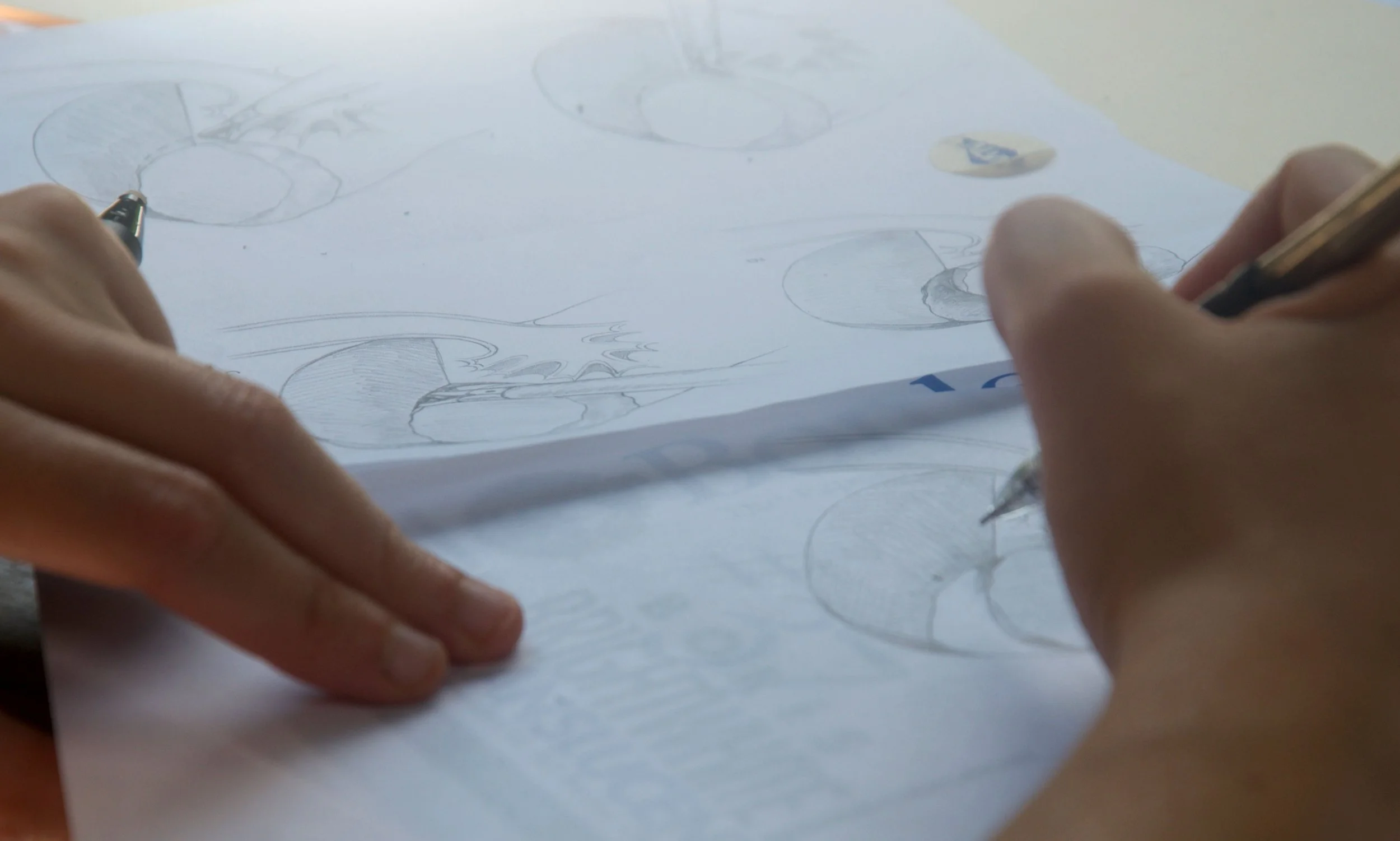
As principal investigator, I conducted an industry collaboration study with AQUASTAR, Inc., a Japanese company that employs, trains, and develops illustrators for commercial visual content production, and one of the rare organisations of its kind in the world. Together, we set out to illuminate the full scope of illustrators' knowledge, encompassing technical skills, cognitive strategies, and the broader factors that shape decision-making during illustration production within their professional community. The ultimate aim was to apply these findings to the development of a clinical sketch curriculum for physicians.
Research shows that approximately 90% of physicians draw illustrations in clinical settings to share information with patients (Kearns, 2019). Yet no curriculum currently exists to teach them to do so effectively. A scale for evaluating physician-drawn medical illustrations has been developed through collaboration between medical schools and fine arts departments (Siegel et al., 2023), which is a pivotal step. However, a scale was charactarised for assessing illustrations, which means that what remains absent is any articulation of what illustrators should be able to achieve, and at what level, and what constitutes a basic or foundational competency in illustration.
This absence is characteristic of illustration as a realm. Illustration techniques are predominantly treated as tacit knowledge (Budge, 2016), knowledge that lives inside communities of practice, transmitted through immersion rather than explicit instruction, and rarely surfaced for those outside those communities (Fauchon & Gannon, 2018; Styhre, 2010).
To address this, and utilising my positionality as an artist, I employed Cognitive Task Analysis (CTA) through focus group interviews with twelve professional illustrators at AQUASTAR, Inc., treating them as an epistemic community in Goodwin's (1994) sense of a group whose shared training, ideology, and daily practice constitutes a distinctive professional vision. The analysis revealed a hierarchical structure of knowledge organised into three broad types: Technical Knowledge (comprising five subcategories and thirteen specific techniques), Cognitive Knowledge (seven strategies), and what we termed Complexity Factors (six additional influences). This is the first step toward setting a prototype of a clinical sketch curriculum, and the planned pathway for building it follows a three-stage logic.
First, identify the foundational knowledge required for illustration broadly (this research). Second, consult experienced medical illustrators or curriculum coordinators of medical illustrator degree programmes to determine which competencies are relevant to medical illustration specifically, and where gaps require additional techniques. Third, work alongside physicians and professional illustrators to narrow these down further or identify clinical-context-specific skills.
Interestingly, Purpose Clarification, the act of continuously checking and embedding communicative intent, was present throughout every stage of production. This continuous intentionality is precisely what current generative AI illustration finds difficult to replicate (Demmer et al., 2023). It could also illuminate the value of human-made illustrations in clinical settings, the ongoing relevance of medical illustrators, and something broader about what illustration as practice-based knowledge actually is.
This article is based on the open access published work:
Oya-Haragi, M., Kudo, K., Oga, T., & Kiuchi, T. (2025). Unpacking professional vision: a cognitive task analysis of illustrators’ liminal knowledge. Cogent Arts & Humanities, 12(1), 2582056.
References:
Budge,K. (2016). Teaching art and design:Communicating creative practice through embodied and tacit knowledge. Arts and Humanities in HigherEducation, 15(3-4), 432-445.
Demmer,T. R., Kühnapfel, C., Fingerhut, J., & Pelowski, M. (2023). Doesan emotional connection to art really require a human artist? Emotion andintentionality responses to AI-versus human-created art and impact on aestheticexperience.Computers in Human Behavior, 148, 107875.
Fauchon,M., & Gannon, R. (2018). Anintroduction to the manifesto for illustration pedagogy: A lexicon forcontemporary illustration practice.Journal of Illustration, 5(2), 207-223.
Kearns,C. (2019). Is drawing a valuable skill insurgical practice? 100 surgeons weigh in. Journal of visual communication in medicine, 42(1),4-14.