

Ulrike Schmidt
Veronica Yakimovich
25 August, 2026
Interview
Zofia Chamienia for EDIFY
Could you please introduce the EDIFY project and the main idea behind creating it?
EDIFY is a large research program that focuses on early intervention for eating disorders. Early intervention for eating disorders is much behind, for example, early intervention for psychosis or other mental health problems. And yet, eating disorders affect young people. They typically start in adolescence or young adulthood, between ages 15 and 25. Thus, the question is: can we better understand what goes on during this period, what factors make someone ill, and what factors help people recover from illness?
In EDIFY, we brought together scientists from very different backgrounds: neurobiologists, arts and humanities researchers, social scientists, psychiatrists, psychologists, and clinical academics, like myself.
We have six work streams. There is a work stream that focuses on risk; it uses different cohorts to understand how people get into an eating disorder. Then we have a recovery work stream that focuses on using smartphones and wearables to follow a cohort of 900 young people for one year to map their recovery journeys. We also have an intervention work stream, where we wanted to investigate new technology - intermittent theta burst stimulation - in young people who had been through treatment for their anorexia and hadn't recovered, to acknowledge that early intervention is not giving up on people who have more persistent symptoms. It was particularly the young people who advised on the program, who were very keen for this intermittent theta burst stimulation to be included as a second stage of treatment when your first-line treatment hasn't worked, and you're still left with symptoms.
From the start, we've had very strong youth involvement. We've had about 15 youth advisors, and we've worked with them creatively across our different workstreams to involve them in setting up the studies and to inform the study design. For example, in the study using remote measurements, we initially thought of giving people a Fitbit, the device where you can track how many steps you’ve done, how many calories you’ve burned. But our youth advisors said they would resign if we used this, because it would be triggering. In the end, we decided to use Oura Rings, smart rings which look like a funky piece of jewellery and let you disguise the feedback. Young people were very keen on it.
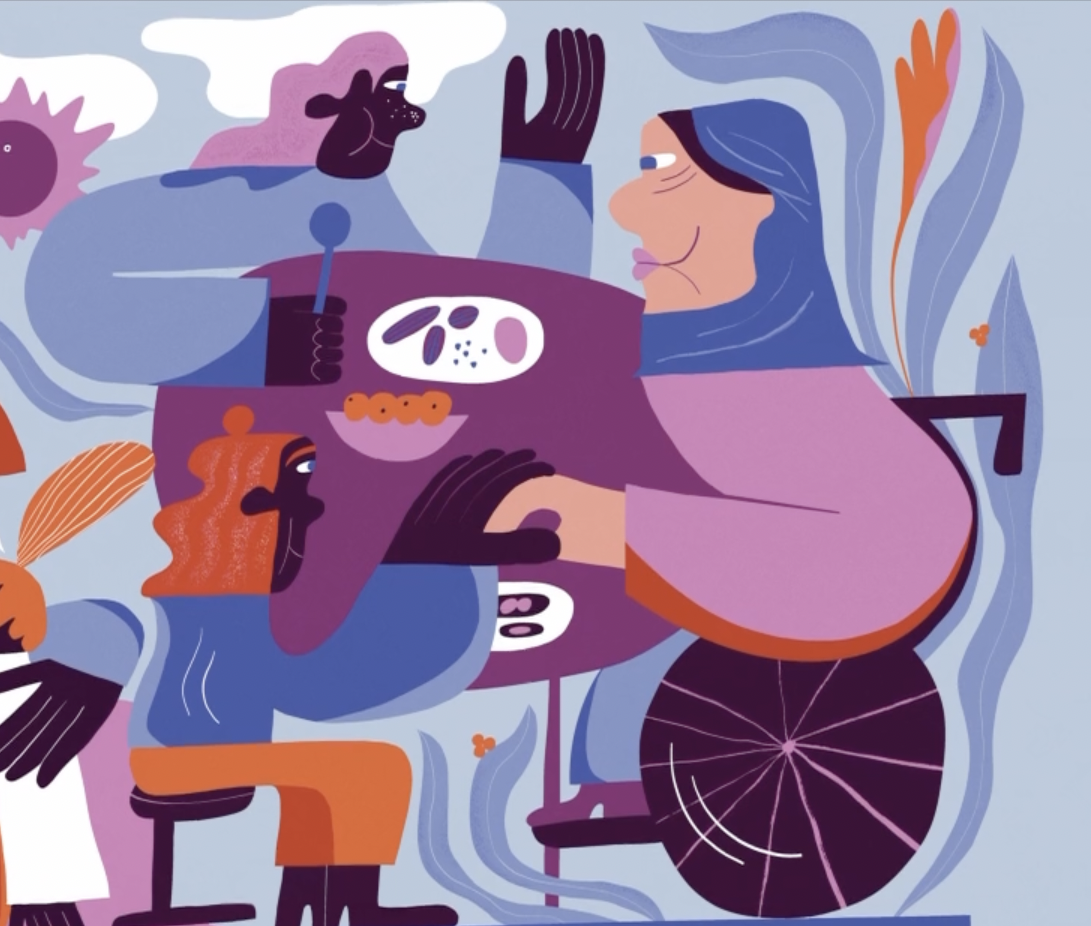
We also have projects that work directly with young people to help them think where the gaps are in treatment and care for eating disorders. We had colleagues from the Glasgow School of Art involved, who used design-based approaches to help young people map out what they think should be done differently in eating disorder services. One of our artists in residence, Zofia Chamienia, then translated this into colourful, joyful graphic illustrations that depict people of all shapes and sizes, because we also wanted to convey that eating disorders affect a very diverse population.
So, it's a very big, very fluid research programme. There are lots of spin-off projects that have involved artists and required creative work and the use of different methodologies. For example, we had an associate researcher who used PhotoVoice methodology to find out from young people with eating disorders where their turning point on the way to recovery had come and what are the objects that embody this turning point. Then we had an exhibition around objects that represent these turning points. It was interesting because the objects often had nothing to do with eating or weight, like scales or food. Instead, they were something to do with other people or activities that helped facilitate change, for example.
In your research, you work extensively with lived experience, and I wanted to know more about the specific methods you used for co-creation with young adults. How did you involve them so they felt a sense of agency over the research project?
In part, having a large group of young people involved gives them a degree of agency. We didn’t have just one young person and 20 researchers, who are 20 years older than them. Instead, we had 15 youth advisors who were very involved in the meetings. A smaller number of young people were then allocated to each workstream, based on their interests. Some were neuroscience students and had had an eating disorder, who might be very interested in the neuroimaging studies. Others were more artsy, and they worked with our Glasgow School of Art collaborators. People had a lot of choice in how they wanted to be involved and what they wanted to do.
Among other things, we had lived experience involvement in three animated films we made about underserved groups in eating disorders, such as living with food insecurity, having an eating disorder when you're bigger, and being from minoritised ethnic backgrounds.
We also made sure that young people could choose times when they wanted to be involved depending on their own lives. A lot of them were still in education, so asking them to read a study protocol would have been too boring and too much on top of their studies. But at other times, they might be willing to come to a workshop or help choose our artists-in-residence.
Video from: https://www.youtube.com/watch?v=JBmOI8xKAc8
What are the main challenges of identifying eating disorders early on, and how do you think future healthcare professionals should be taught the preventative approach?
Very good question. In the early phases of eating disorders, people often get a lot of positive reinforcement. So, if you were a bit plump and then lost some weight, your friends might say that you look great, that you have such wonderful willpower not to eat, and so on. That makes it a really tricky phase.
And what can you do as a health professional? Screening questionnaires and screening questions are important. And to do them kindly.
I think compassion is the most important skill. Eating disorders evoke reactions in people: either you get very scared if you're with someone who you think is going to drop dead very quickly, and the person says, 'I don't want your help.' It's designed to make the medic say, 'You must eat,' 'We will bring you into hospital against your will,' and so on. It becomes very overpowering and forceful. In moments like this, it is important to slow down, be motivational and compassionate, and step back amid this medical urgency.
The other extreme is when you have people who are at a higher weight and who binge or make themselves sick, this often evokes very moralistic, trivialising ideas of gluttony. The animation about people in larger bodies has shown that people often immediately get told by health professionals who they see, 'Why don't you lose some weight?' rather than the professional checking whether the person has any eating disorder symptoms, such as distressing episodes of binge eating, which may need treating. Therefore, health professionals need to be trained to think broadly beyond anorexia.
Young people growing up in poverty and food insecurity may be particularly prone to developing eating disorders. Some may think that people living with food insecurity might not eat for a few days and then overeat when they get some food, and then it stops. But it doesn't, because it creates brain changes that then keep you more binge-prone in the longer term.
Therefore, for health professionals, it is important to think beyond the stereotypes, to be compassionate, to be open, and to slow down when faced with a medical emergency and help draw out the patient's own concerns.
I wonder how you balance the social factors with biological factors when looking at the development and treatment of eating disorders, because I assume they're very intertwined.
We combined them very much in the research. In all our cohorts, we tried to include questions and collect data on biology, such as neuroimaging over time, but we also looked carefully at psychosocial factors, such as social media use.
During COVID, there was a massive increase in eating disorders, especially among young people with anorexia, which taught us that very clearly there were some environmental and social factors that contributed. For example, during COVID, young people spent more time on social media, where people were bombarded with health messages. It was also often the time of increased family conflict because you were stuck together, and young people were separated from their peers. It was a perfect storm where, if you had a biological vulnerability, all these social factors would pile on to drive you in the direction of an eating disorder.
I think we see it much clearer now how eating disorders are biopsychosocial in origin; it's not just social media that gives you an eating disorder, and it's not just genetics - it's all these factors together.
You made a film together with Common Films about the artists you collaborated with for EDIFY. Why was it important to include artists’ perspectives, and what have you learned from this interdisciplinary approach?
I should say that our funders had specified that they wanted art-based approaches involved. It would never have occurred to me to involve any artists in our research programmes, but it's been one of the best things I've ever done. I’ve learned so much about how both science and art are creative in very different ways, and how artists help us reach hearts and minds in a much better way than we can with our dry scientific papers.
We included the four artists-in-residence, as well as the animators with whom we've worked to make the films, because they've been so brilliant at translating some of our work.
It’s not been totally easy either. I initially thought we would have artists work on something closely aligned with specific findings from a particular study, but the findings hadn't yet emerged when we involved the artists. Also, there is the question of whether it is desirable to be very prescriptive or let the artists respond to the research and work with the researchers. We received good advice from our King's Culture Institute, which said to give artists the freedom to do what they pick up.
For example, the artist Sian Fan created small digital objects that served as both remote technology devices and personal charms. She wore an Oura ring for a period of time, and she used her experience of how that made her feel to have her vital functions monitored to influence her work in a very clever way.
Ivana Picek, our musician, used the ITBS (Intermittent Theta Burst Stimulation) noises to weave them into one of her songs, which I thought was great. Something scary and cold becomes part of something warm and more universal.
Our textile artist, Maeve Magnolia Gillespie, works with broken or discarded materials. Many of our patients have this experience of feeling broken: ‘Who will I be without my anorexia?’ And this process of mending things, using discarded materials to make something whole and beautiful, was wonderful. Also, working communally was a healing experience for those who participated in making the enormous quilt that Maeve produced.
Video from: https://www.commonfilms.co/edify
Additional resouces:
Animations:
· Eating Disorders in People with Higher Weight
· Food Insecurity in Eating Disorders
· Eating Disorders, Ethnicity and Culture
Interview with Paul Craddock, co-founder of the Common, about using film as a research method